Yanagisawa
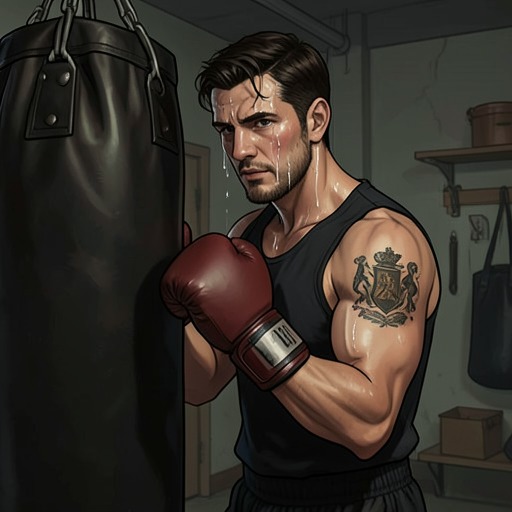
A ManYanagisawa is a retired professional boxer and former training partner of Makoto Hara whose recognition of X helps Kido establish Hara’s identity and whose memories reveal the anguish behind Hara’s withdrawal from a defining fight. He is more than a witness to a past career: his recollections turn a photograph and a boxing-club interview into an account of Hara’s loneliness, inherited stigma, and intimate distress.
Identity and Introduction
Yanagisawa introduces himself to Kido in the office of the boxing club where Hara once trained. A few years older than Hara, he had trained with him as a professional boxer; now retired, he works at a fishing-gear shop in the Kinshicho area and gives Kido its business card. His present occupation marks the distance between the men’s former sporting lives and the investigation that brings their histories back into view.
Kido briefly recaps the circumstances leading to their meeting and shows Yanagisawa and Kosuge a photograph of X. Both men recognize him immediately as Makoto Hara. Yanagisawa’s identification is important because it links the face in Kido’s investigation to the boxer he knew personally, rather than merely to a name or a disputed account.
A Former Training Partner
Yanagisawa remembers Hara as exceptionally talented: he was much better than Yanagisawa, though Yanagisawa cannot say whether Hara had the ability to become champion. Their different weight classes kept them from competing against one another, and Yanagisawa says that this helped them become close. His assessment combines admiration for Hara’s skill with the ease of a relationship built through shared training rather than rivalry.
That closeness gives weight to the episode Yanagisawa shares with Kido. He does not describe Hara’s breakdown from rumor or distant observation. He had run with him in the mornings, knew the pace of their usual roadwork, and was beside him when Hara suddenly could not continue. The friendship makes the scene personal evidence of distress, not simply a dramatic anecdote about a boxer under pressure.
The Run Before Hara’s Decision
As Hara approached a decision about whether to take part in a fight, Yanagisawa invited him out for their usual morning run. They were running hard until they reached a local park, where Hara began to fall behind. Yanagisawa looked back, saw him stop, and watched him sink to his knees as if his strength had left him. Hara then fell forward onto his stomach and cried, rubbing his face into the dirt and wailing in the middle of the park on a morning cold enough for frost.
Yanagisawa’s account gives Kido a precise, embodied image of a crisis that might otherwise be described only as a career decision. Hara’s collapse happens during routine roadwork, before the fight, and in an ordinary local park; the contrast between the familiar run and the sudden loss of control makes the distress unmistakable. Kido imagines the scene with such force that his chest tightens, and he thinks he may have passed that same park while walking from the station.
What Yanagisawa Understands About Hara
Yanagisawa recalls that he told Hara he did not have to go through with the decision. Whatever the company president had said, Hara was under no obligation to speak with the family of the murder victim; Yanagisawa believed that Hara would only make them uncomfortable. His counsel was a direct attempt to release his friend from an obligation that, in Yanagisawa’s view, would burden both Hara and the bereaved family.
He understands the crisis as having several sources, rather than a single cause. Hara had taken up boxing because he was tired of being an outsider, but, as the moment to shine approached, Yanagisawa thought Hara feared criticism over who he was. He also connects Hara’s hesitation to the death of a friend and to Hara’s feeling that he owed that friend something. Yanagisawa’s account therefore presents the fight decision as entangled with belonging, public scrutiny, bereavement, and obligation.
Yanagisawa describes Hara’s sense of estrangement through the image of being trapped in a body that does not fit. He compares Hara’s experience to what he calls gender identity disorder, explaining that Hara spoke about his body and felt as though he were stuck for life inside a repulsive mascot suit. When Kido asks whether he means that Hara was seen as the child of a death-row convict, Yanagisawa says that this was part of it, but not the whole of it. He adds that Hara and his father were almost mirror images physically, linking the visible resemblance to an identity Hara experienced as imposed and painful.
Narrative Role
Yanagisawa’s recollections widen Kido’s understanding of Hara beyond the public facts of boxing and family history. The photograph establishes recognition; the story of the run supplies the bodily, emotional scene behind the decision; and Yanagisawa’s explanation places that anguish amid exclusion, grief, inherited appearance, and the pressure to perform for others. His testimony does not resolve every cause of Hara’s crisis, but it preserves its complexity: a talented boxer, a friend in mourning, and a man distressed by the body and identity through which others saw him.